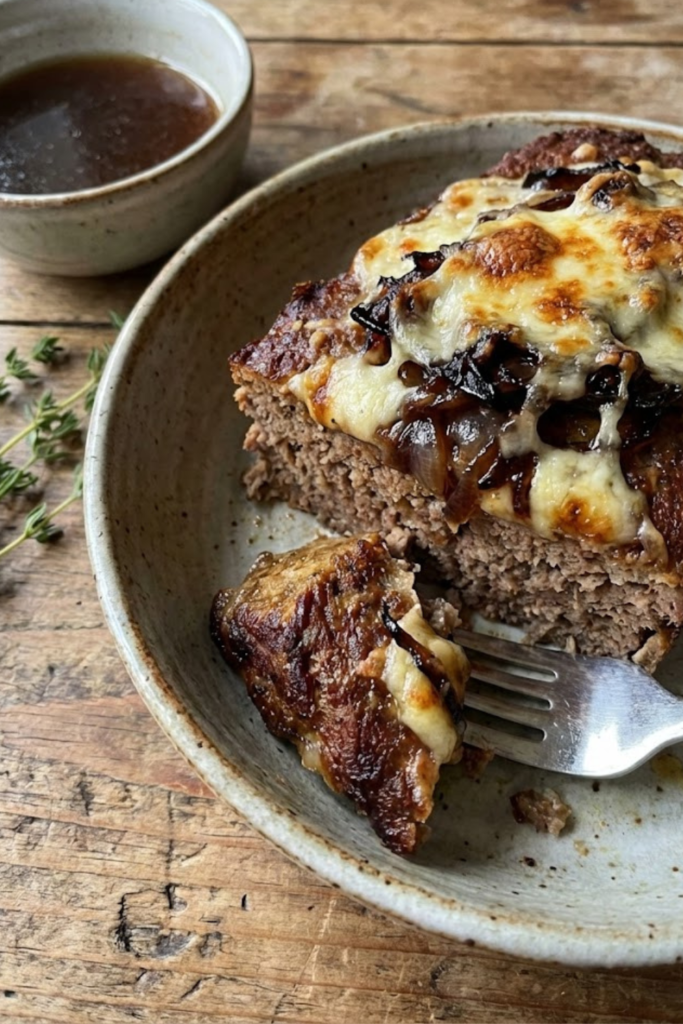
There is no love sincerer than the love of food.” — George Bernard Shaw. If that’s true, prepare to fall head over heels! Most people think of meatloaf as a dry, boring brick from the 1950s, but this isn’t your grandma’s Tuesday night dinner. This is French Onion Meatloaf. Imagine the savory, rich depth of a classic French onion soup colliding with the hearty satisfaction of a perfectly glazed meatloaf. It is an absolute game-changer!
In this article, we aren’t just throwing ingredients in a bowl; we are crafting a dinner masterpiece. You’ll learn how to incorporate sweet caramelized onions directly into the meat mixture and top it all off with that signature melted cheesy goodness. Get your forks ready!
Mastering the Art of Caramelized Onions
I have a confession to make. The first time I tried to make caramelized onions, I was a total disaster in the kitchen. I cranked the heat up to “high” because, honestly, who has forty minutes to watch onions cook? I thought I could outsmart the process. Spoiler alert: I couldn’t. Instead of sweet, golden goodness, I ended up with a pan full of black, bitter charcoal. It was nasty.
But here is the thing I learned the hard way. The secret to a mind-blowing French onion meatloaf isn’t the meat; it’s the love you put into those onions. If you rush this step, you’re just making a hamburger in a loaf shape. We want that deep, savory richness that makes people close their eyes when they take a bite. So, grab a stool and get comfortable, because we are going to learn how to do this right.
Picking Your Fighter: The Right Onion
You might think an onion is an onion, right? Not exactly. When I’m prepping this meal for my family, I almost exclusively reach for yellow onions or sweet Vidalia onions.
Red onions are great for salads, but they turn a weird gray color when cooked down this long. White onions are a bit too sharp. Yellow onions, however, have this perfect balance. They get incredibly sweet as they break down. That natural sugar is what we are after! It balances out the savory salty taste of the beef and cheese later on.
The Butter and Oil Team-Up
Here is a trick I picked up after ruining a few batches. If you use just butter, it burns before the onions are done. If you use just oil, you lose that rich flavor.
So, what’s the fix? Use both! I throw a knob of unsalted butter and a splash of olive oil into the pan together. The oil protects the milk solids in the butter from burning, and the butter gives you that creamy mouthfeel. It is the best of both worlds.
The Patience Game (Low and Slow)
This is the part where I usually get frustrated. You have to keep the heat on medium-low. Not medium. Definitely not high. You want to gently coax the sugars out of the vegetable.
Stir them every few minutes. At first, it looks like nothing is happening. You might think, “Is this stove even on?” But around the 20-minute mark, the magic starts. The kitchen will start to smell amazing.
Don’t panic if they look like a huge mountain of raw veggies at the start. They shrink a lot. A full pan of raw slices will cook down to maybe a cup of caramelized onions. It feels like a magic trick, but it’s just science!
Scrape Up the Good Stuff
Once your onions are a deep, golden brown—usually after about 30 to 40 minutes—you will see brown sticky bits on the bottom of the pan. That is called the fond, and it is pure flavor gold.
Don’t scrub that away in the sink! Pour in a little beef broth or a splash of balsamic vinegar. As the liquid hits the hot pan, use a wooden spoon to scrape those brown bits up. This creates a quick little syrup that coats the onions. It adds a depth that makes your French onion meatloaf taste like it came from a fancy bistro. Trust me, this step is a game changer.

Gathering Essential Ingredients for Savory Success
You know that feeling when you start cooking and realize you are missing the one thing you actually need? I have been there way too many times. There was this one Tuesday—I remember it vividly—when I tried to make meatloaf with whatever I had in the fridge. I used super lean turkey and some old cheddar. Let’s just say my family ordered pizza that night. It was dry as a bone and tasted like sadness.
So, before we even touch a mixing bowl, we need to talk about the grocery haul. If you want that rich French onion flavor, you can’t just wing it. The ingredients are the foundation of the house we are building.
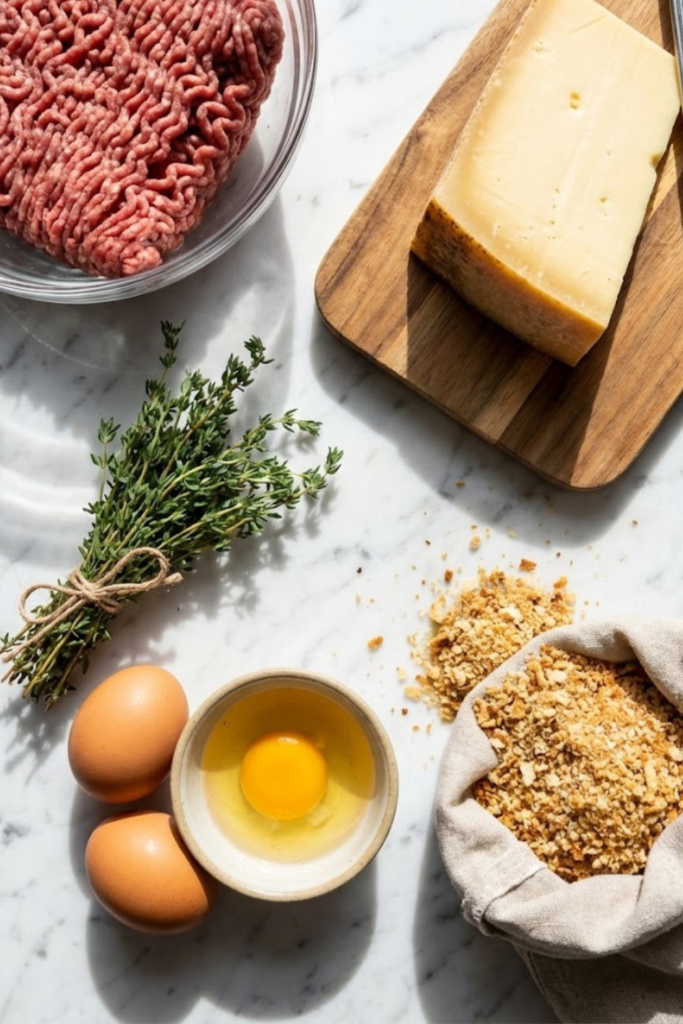
The Meat Matters (Don’t Go Too Lean!)
Here is the biggest mistake I see people make. They try to be “healthy” and buy the 90% lean ground beef. Please, for the love of food, put that back on the shelf!
For a juicy loaf, you need fat. Fat equals flavor and moisture. I always grab the 80/20 ground chuck. That 20% fat content renders down while it cooks, keeping everything moist. If you go too lean, you end up with a hockey puck. I learned this after serving my poor husband a “healthy” meatloaf that required a gallon of water to swallow. It was embarrassing. Stick to the 80/20 blend; your taste buds will thank you.
The Secret Binder: Why You Need a Panade
“Panade” sounds like a fancy French word, doesn’t it? It sounds intimidating. But honestly, it is just a paste made of starch and liquid.
I used to just throw dry breadcrumbs into the meat and hope for the best. Big mistake. The dry crumbs just suck the moisture right out of the beef. Instead, you need to soak your panko breadcrumbs in milk for a few minutes before mixing. It creates a mushy paste that keeps the meat fibers from tightening up too much. This little trick is the difference between a tender slice and a rubbery block. It’s a total game changer.
Cheese: The Gruyère Dilemma
Okay, let’s talk about the cheese. To get that authentic soup vibe, you really want Gruyère cheese. I know, I know—it costs a pretty penny at the store. I definitely hesitated the first time I saw the price tag.
“Can’t I just use mozzarella?” I asked myself. You can, but you shouldn’t. Gruyère has this nutty, salty funk that melts beautifully. If you absolutely can’t find it or don’t want to splurge, a decent Swiss cheese is a solid backup. But don’t use the processed sliced stuff wrapped in plastic! Grate it yourself from a block. Pre-shredded cheese is coated in potato starch to keep it from clumping, and it never melts right.
The Flavor Boosters
Finally, we need to punch up the savory notes. Salt and pepper are obvious, but the real heroes here are fresh thyme and Worcestershire sauce.
I used to use dried thyme because I was lazy. It’s fine in a pinch, but fresh thyme leaves really brighten up the heavy flavors of the beef and cheese. And Worcestershire sauce? It adds that “umami” bomb. It makes the beef taste… beefier. I usually eyeball it, but don’t be shy with it.
Getting these specific meatloaf ingredients together might take an extra ten minutes at the store, but it is 100% worth it. We aren’t making cafeteria food here; we are making a masterpiece!
Crafting the Perfect Meat Mixture and Shaping
I remember the first time I made meatloaf for a dinner party. I wanted it to be perfect, so I mixed that meat like I was kneading dough for a sourdough bread. I really got in there, squeezing and mashing for like ten minutes.
When I took it out of the oven, it wasn’t a meatloaf; it was a meat brick. Seriously, if I had dropped it on the floor, I think it would have cracked a tile. It was dense, tough, and honestly, pretty embarrassing. That’s when I learned the golden rule: treat the meat like it’s fragile.
The Claw Hand Technique
You might be tempted to get in there with a wooden spoon or a spatula. Don’t do it. Your hands are the best tools you have in the kitchen. But you can’t just squeeze it.
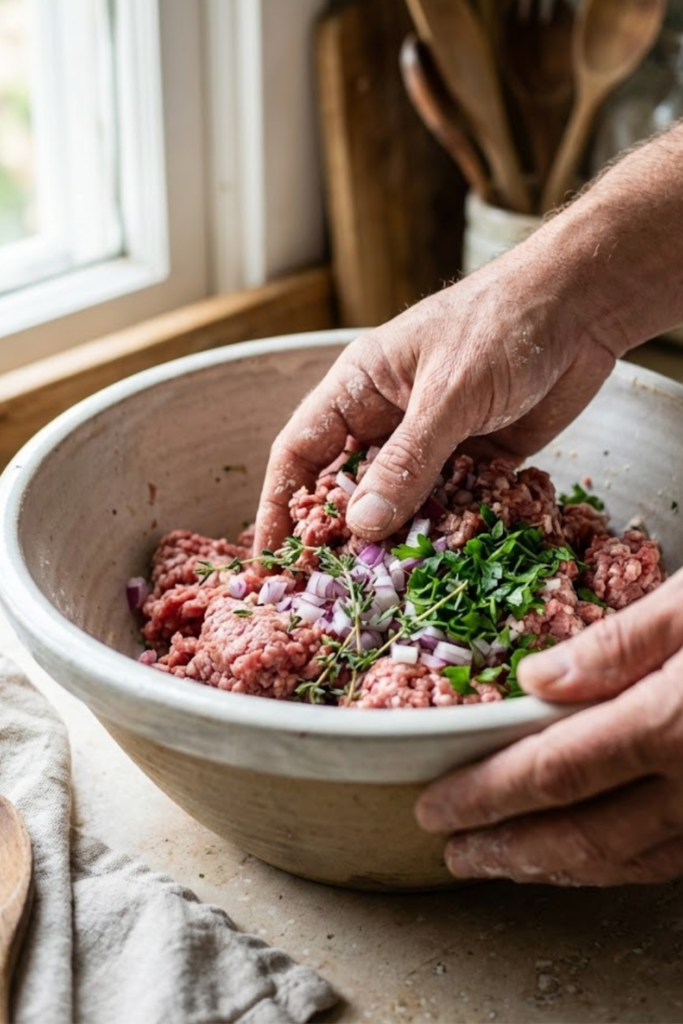
I use what I call the “claw hand” method. Spread your fingers apart like a claw and gently toss the ground beef mixture. You want to lift and fold, not smash. It’s kind of like tossing a salad. You stop mixing the second—and I mean the second—the ingredients look combined. This keeps the texture light and tender, so it melts in your mouth instead of chewing like a tire.
Folding in the Gold
Now comes the best part: adding those beautiful caramelized onions we slaved over earlier. This is where the magic happens for our French onion meatloaf.
Make sure the onions have cooled down a bit before you dump them in. If they are piping hot, they will start cooking the raw eggs in the mixture, and that is just gross. I usually let them sit while I prep the other stuff. Gently fold them in so you get nice ribbons of sweet onion in every single bite. You don’t want one slice to be all onion and the next slice to be plain beef.
Ditch the Loaf Pan
Here is a hot take that might upset some grandmas out there: stop using a loaf pan! When you stuff the meat into a deep pan, it steams in its own juices. It gets soggy and gray on the sides.
Instead, I grab a rimmed baking sheet and line it with a piece of parchment paper. I dump the mixture right onto the sheet and use my hands to shape it into a log, about 9 inches long and 4 or 5 inches wide. This allows the heat to hit the loaf from all sides. You get that delicious, browned crust all the way around, not just on top. Plus, the clean-up is way easier, which is always a win in my book.
The Divot Trick
Have you ever baked a meatloaf and it comes out looking like a football? It swells up in the middle and the glaze slides right off the sides. It’s annoying.
To fix this, I learned a simple trick from a chef friend. Before you pop it in the oven, use your hand to press a shallow trench or divot down the center of the loaf. It looks a bit weird raw, but trust me. As the meat cooks, it puffs up. That divot fills in, leaving you with a perfectly flat top that holds onto all that extra glaze and cheese we are going to add later. It’s a small detail, but it makes a huge difference in how the final dish looks and tastes.
Baking to Perfection: Temperature and Glazing
I have a bit of a embarrassing story for you. A few years ago, I made a beautiful meatloaf for my in-laws. I was so confident. I pulled it out of the oven when it “looked done” on the outside. We sat down, I cut into the middle, and… it was pink. Not a nice medium-rare steak pink, but “raw ground beef” pink. I wanted the floor to open up and swallow me whole. We had to microwave the slices. It was tragic.
That was the day I stopped guessing and started using science. Baking isn’t just about heat; it’s about precision. If you want this French onion meatloaf to be safe to eat but still juicy, you have to pay attention to the numbers.
The Magic Number: 350°F
First things first, don’t blast this thing with high heat. I preheat my oven to 350°F (175°C). It seems like a standard temperature, but there is a reason for it.
If you go higher, like 400°F, the outside burns before the inside cooks. If you go lower, it takes forever and the meat steams instead of roasting. At 350°F, you get a gentle, steady roast. It gives the fat time to render slowly, basting the meat from the inside out. It fills the house with that incredible savory smell that makes your stomach growl.
Trust the Thermometer, Not Your Eyes
Please, do me a favor and buy a meat thermometer. They are cheap, and they save you from the “raw meatloaf” nightmare I lived through. You are looking for an internal temperature of 160°F (71°C).
I usually start checking it around the 45-minute mark. Stick the probe right into the thickest part of the center. If it says 155°F, you are close! Don’t wait until it hits 165°F or 170°F in the oven, or it will be dry by the time it hits the table. Carry-over cooking will finish the job once you take it out. This is the single best tip for juicy beef.
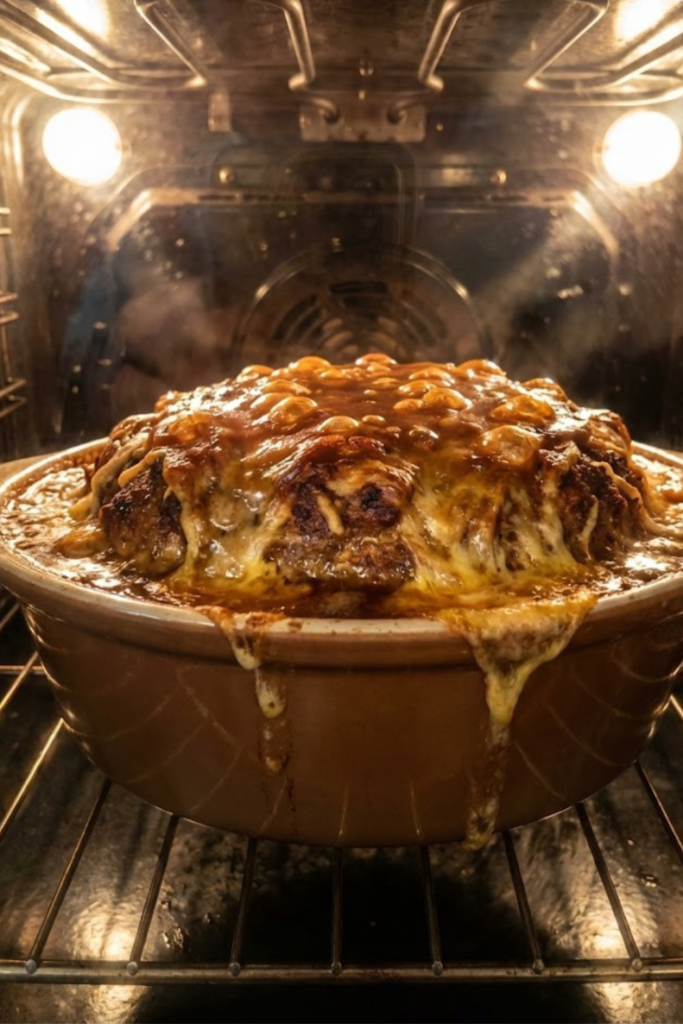
The Gooey Cheese Finish
Now, for the best part. The pièce de résistance. About 10 minutes before the meat hits that perfect temperature—so when it’s around 145°F or 150°F—pull it out of the oven.
It’s time to turn this into a French onion soup masterpiece. Take the rest of your shredded Gruyère cheese and pile it on top. I mean really pile it on. Pop it back in the oven. You want that cheese to melt and bubble down the sides. If you’re feeling brave, switch the oven to broil for the last minute to get those brown, crispy spots on the cheese. Just don’t walk away, or you’ll burn it!
The Hardest Step: Resting
Okay, the timer went off. The cheese is bubbling. You are starving. You want to slice it immediately. Stop! Put the knife down.
If you cut into it right now, all those delicious juices will run out onto the cutting board. Your meat will end up dry, and your plate will be a soggy mess. You have to let it rest for at least 10 to 15 minutes.
I know it’s torture. I usually distract myself by washing a few dishes or pouring a glass of wine. This resting time lets the juices redistribute throughout the loaf. When you finally slice it, every bite is moist and flavorful. It’s worth the wait.
Serving Suggestions and Side Dish Pairings
I have a rule in my house: the main dish is the star, but the sides are the backup dancers. And let’s be real, nobody wants to watch a concert where the backup dancers are tripping over their own feet. I once served this luscious, cheesy meatloaf with a side of plain, boiled cauliflower because I was trying to be “low carb.” My family looked at me like I had just canceled Christmas. It was a total flop.
You need sides that can stand up to these big flavors without getting lost. This isn’t just a quick Tuesday feed; it’s a comfort food dinner event. You want to build a plate that makes sense.
The Potato Mandate
Let’s not overthink this one. If you are making meatloaf, you pretty much have a moral obligation to serve mashed potatoes. It’s the law of the universe. But for this specific recipe, it serves a practical purpose too.
When you cut into that loaf, you are going to have these amazing, savory juices running everywhere. You need a fluffy pile of starch to soak up that liquid gold. I like to keep my mash simple—butter, milk, salt, and plenty of pepper. You don’t need to get fancy with garlic or herbs in the potatoes because the meat is already packing so much flavor. Just make a little volcano in the mash and let the gravy flow. It’s heaven.
Adding a Crunch Factor
Since the meatloaf and potatoes are both soft textures, you need something with a bit of snap to wake up your palate. If everything on the plate is mushy, it gets boring fast.
My go-to is roasted garlic green beans or asparagus. I toss them on a separate sheet pan with olive oil and salt and throw them in the oven while the meatloaf is resting. The bitterness of the greens cuts right through the richness of the Gruyère cheese and beef. It cleans your palate so you are ready for the next bite. Plus, it adds a pop of color so your plate isn’t just fifty shades of brown.
The “Crouton” Element
Here is where we lean into the “French Onion Soup” theme. What is the best part of that soup? It’s the soggy, cheesy bread on top, right?
To mimic that experience, I always slice up a fresh baguette. I toast it slightly so it’s essentially giant crusty bread croutons. You can use it to mop up the caramelized onions that fall off your fork. It really ties the whole concept together. If you want to go the extra mile, rub a raw clove of garlic on the toasted bread. It’s a tiny detail, but it makes the meal feel like something you’d pay $25 for at a restaurant.
A Little Vino to Wash it Down
Finally, if you are inclined to have a drink with dinner, you can’t go wrong with a glass of red wine. Since we are dealing with beef and onions, you want a medium-bodied red.
I usually grab a Pinot Noir or a Merlot. You don’t want something too heavy like a Cabernet Sauvignon that will overpower the sweet onions. The acidity in a lighter red wine helps balance the fat in the cheese. It makes the whole meal feel fancy, even if you are just eating in your sweatpants on a Wednesday night. And honestly, isn’t that the goal? To feel fancy in sweatpants? That is my definition of success.
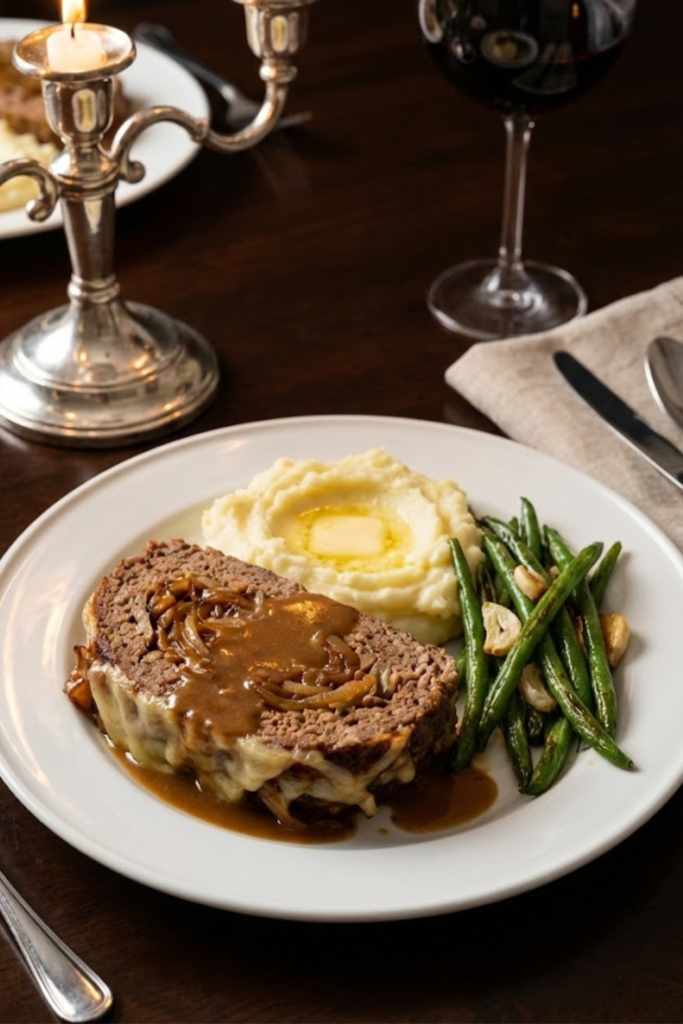
This French Onion Meatloaf isn’t just a meal; it’s a warm hug on a plate. By combining the rich, sweet notes of caramelized onions with the savory punch of beef and Gruyère cheese, you’ve elevated a humble classic into something restaurant-worthy. It is juicy. It is cheesy. It is absolutely unforgettable!
I know we all get stuck in a rut making the same tacos or spaghetti every week. It happens to the best of us. But this recipe proves that with just a few extra ingredients, you can turn a boring staple into a superstar. It might take a little patience to brown those onions, but once you take that first bite, you won’t regret a single second of it.
Don’t forget to save this recipe for a rainy day. Pin this mouthwatering recipe to your “Comfort Food Dinner” board on Pinterest so you never lose it!