There is nothing—and I mean nothing—that beats the smell of bacon sizzling on a Sunday morning! Did you know that savory breakfasts are trending up by 35% this year? Well, I decided to combine my love for crispy bacon with the fluffy, buttery goodness of homemade baking to create these Black Pepper Cheddar Bacon Biscuits. Trust me, once you bite into those flaky layers filled with melting sharp cheddar and that spicy kick of cracked black pepper, you won’t want store-bought rolls ever again. I used to be intimidated by making biscuits from scratch, thinking I’d end up with hard hockey pucks. But after years of testing (and eating a lot of crumbs), I’ve found the secret to getting that perfect rise every time. Let’s get baking!

Gathering Your Ingredients for Savory Success
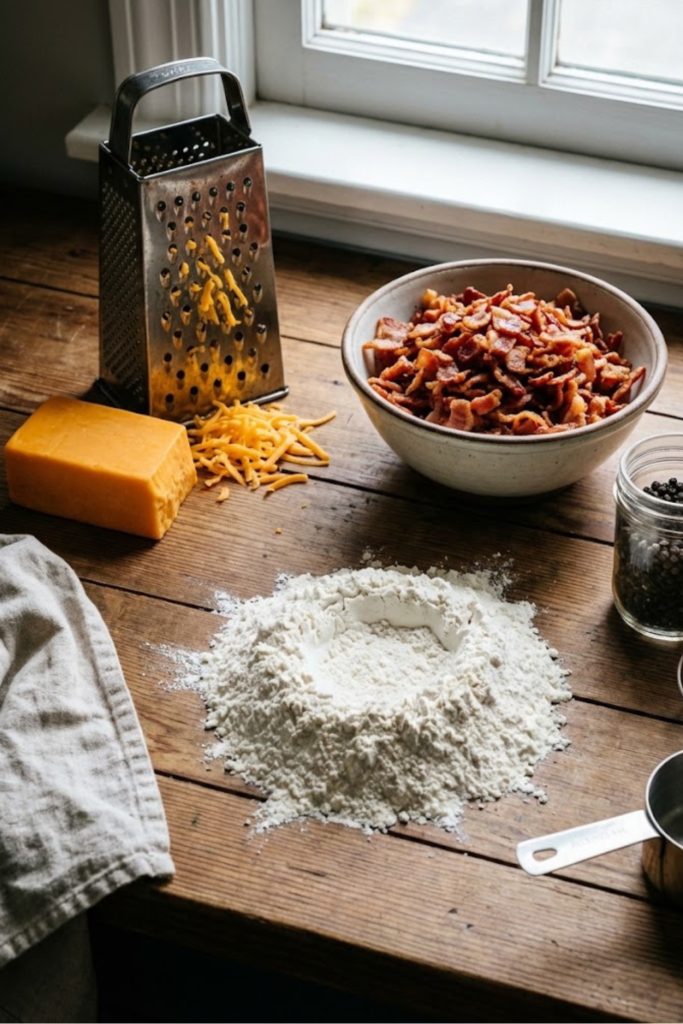
Look, I’ve been there. You’re standing in the baking aisle, staring at seventeen different types of flour, wondering if it actually matters which one you grab. Spoiler alert: it totally does. When I first started messing around with savory baking, I just grabbed whatever was cheapest. big mistake. My biscuits turned out hard enough to break a window. Over the years, I’ve learned that quality ingredients are half the battle. You don’t need the most expensive stuff, but you do need the right stuff. Let’s talk about what you actually need to grab from the store.
The Flour Debacle
For the longest time, I thought “flour is flour.” Wrong! For these biscuits, All-Purpose flour usually works best for most people because it gives enough structure to hold up the heavy bacon and cheese. However, if you can get your hands on White Lily flour, do it. It’s a soft winter wheat flour famous in the South for making things incredibly light.
If you stick with regular All-Purpose, just don’t overwork it. I once tried using bread flour because I was out of AP, and let me tell you, those biscuits were chewy in a bad way. Stick to the basics here.
The Bacon Factor
Here is where things get serious. You want your bacon to be crispy. Like, really crispy. I usually fry my bacon until it’s just on the edge of being too done. Why? Because once you mix it into that wet dough and bake it, it softens up a bit.
If you put limp bacon in, you’ll get rubbery bits in your biscuit. Nobody wants that. I prefer a thick-cut bacon because it holds its own against the sharp cheddar, but regular slices work too if you crisp ’em up right.
The Cheese Grater is Your Friend
Okay, don’t come at me for this, but put the bag of pre-shredded cheese down. Seriously, put it back on the shelf. Pre-shredded cheese is coated in cellulose (wood pulp, basically) to keep it from clumping. That stuff stops the cheese from melting properly.
Grab a block of sharp cheddar and grate it yourself. It takes like two minutes, tops. The difference in meltiness is night and day. Plus, block cheese just tastes sharper and richer. I learned this the hard way when my cheese pockets didn’t melt and just looked like sad, orange confetti.
Check Those Dates
This is the boring part, but it’s crucial. Go check the expiration date on your baking powder and baking soda right now. If it’s been sitting in your cupboard since 2021, toss it. Old leavening agents are the number one reason biscuits turn out flat and sad. Fresh baking powder is what gives you that glorious rise. It’s a small detail, but it makes or breaks the whole recipe.
Mastering the Cold Butter Technique for Flaky Layers
I still cringe thinking about my first batch of “homemade” biscuits. I treated the butter like I was making a cake—I let it sit out on the counter until it was soft and mushy. I thought I was being smart!
Boy, was I wrong. Those biscuits came out looking like flat, sad pancakes. I was so mad I almost threw the whole pan in the trash. It took me a while to figure out that for flaky layers, the rules of the game are totally different. You have to keep everything cold. Like, arctic cold.
Why Temperature Actually Matters
Here is the science part, but I’ll keep it simple. When you put cold chunks of butter into the hot oven, the water inside the butter evaporates rapidly. This creates little steam pockets inside the dough.
Those pockets push the dough layers apart, giving you that tall, flaky texture we all dream about. If the butter melts before it hits the oven, you lose the steam. You lose the lift.
So, here is my rule: I cut my butter into cubes and put it in the freezer for ten minutes before I start. I even put my mixing bowl and flour in the fridge sometimes! It sounds crazy, but it works.
The Grating Trick
If you struggle with cutting butter into the flour, you are not alone. I used to use a fork and just mash it around, getting frustrated. Then I learned the “grating hack.”
Take a stick of frozen butter and use the large holes of a box grater to shred it directly into your flour. It creates perfect little ribbons of fat. Then, you just toss it quickly with the flour to coat it.
This method is a lifesaver if you have warm hands (like me) that tend to melt butter too fast. It distributes the fat evenly without overworking your arms.
Using a Pastry Cutter
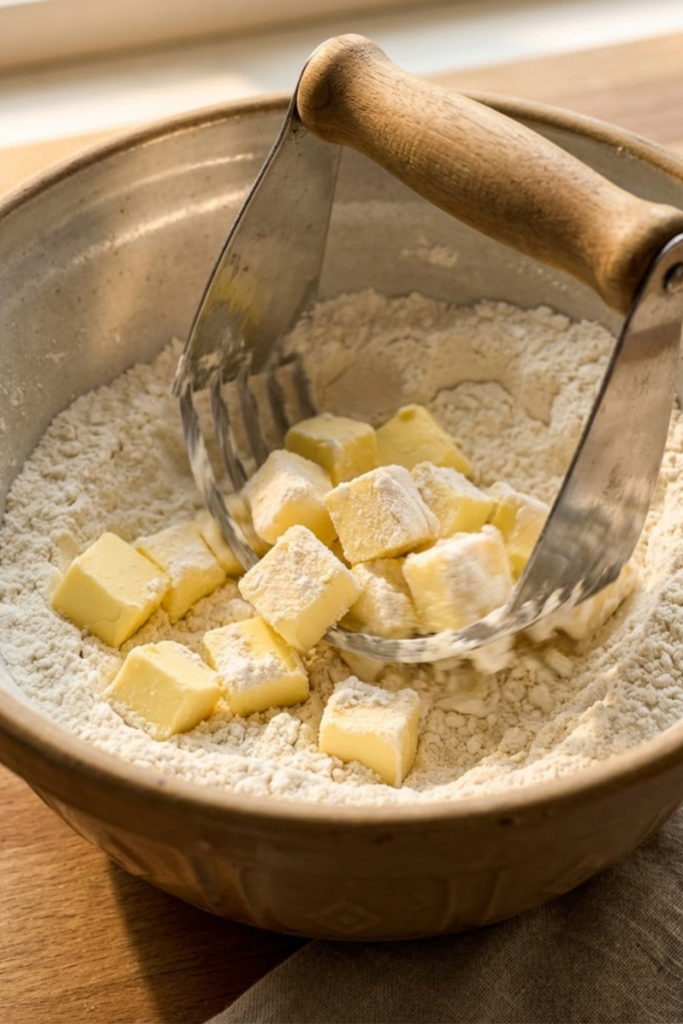
If you prefer the old-school way, grab a pastry cutter. This tool is cheap and effective. You want to press down and twist slightly until the mixture looks like coarse crumbs.
You are looking for pea-sized crumbs. Don’t try to get it perfectly smooth! You want visible chunks of butter remaining. Those chunks are future flakes waiting to happen.
Balancing the Bacon Fat
Since we are adding bacon to this recipe, we have to talk about grease. I usually save a tablespoon of the rendered bacon fat, let it solidify (cold again!), and mix it in with the butter.
It adds a smoky depth that butter alone can’t give you. Just don’t use hot grease! It will melt your butter and ruin the cold butter technique. Keep it chill, and your biscuits will thank you.
Mixing and Folding: The Secret to Tall Biscuits
I have a confession to make. When I first started baking, I treated biscuit dough like bread dough. I kneaded it. I smoothed it out. I made sure every single lump was gone. And you know what? I made bricks. Literal bricks. I was so confused because they looked perfect going into the oven, but came out dense enough to sink a ship.
It took me years to realize that ugly dough is actually happy dough. If you are a perfectionist, this part is going to drive you crazy. You have to fight the urge to make it look pretty. Trust me, the messier it looks now, the better it tastes later.
The Buttermilk Pour
So, you’ve got your flour and butter crumbs sitting there. Now, make a little “well” in the center with your hands. It’s like digging a hole in the sand at the beach. Pour your cold buttermilk right into that hole.
I like to use a fork for this next part. Gently stir the flour into the liquid from the sides. Do not whip it! Just barely toss it around until it starts to look like a shaggy mess. If there is still some loose flour at the bottom of the bowl, that is totally fine.
The Danger of Overmixing
Here is where the magic (or the tragedy) happens. As soon as the liquid touches the flour, gluten starts to form. Gluten is great for pizza crust, but it is the enemy of tender biscuits. If you mix too much, you develop tough strands that won’t rise.
Stop mixing when it looks like it’s barely holding together. It should look craggy and rough. I call it “shaggy dough.” If it looks smooth, you have gone too far, my friend.
The Folding Trick (Lamination)
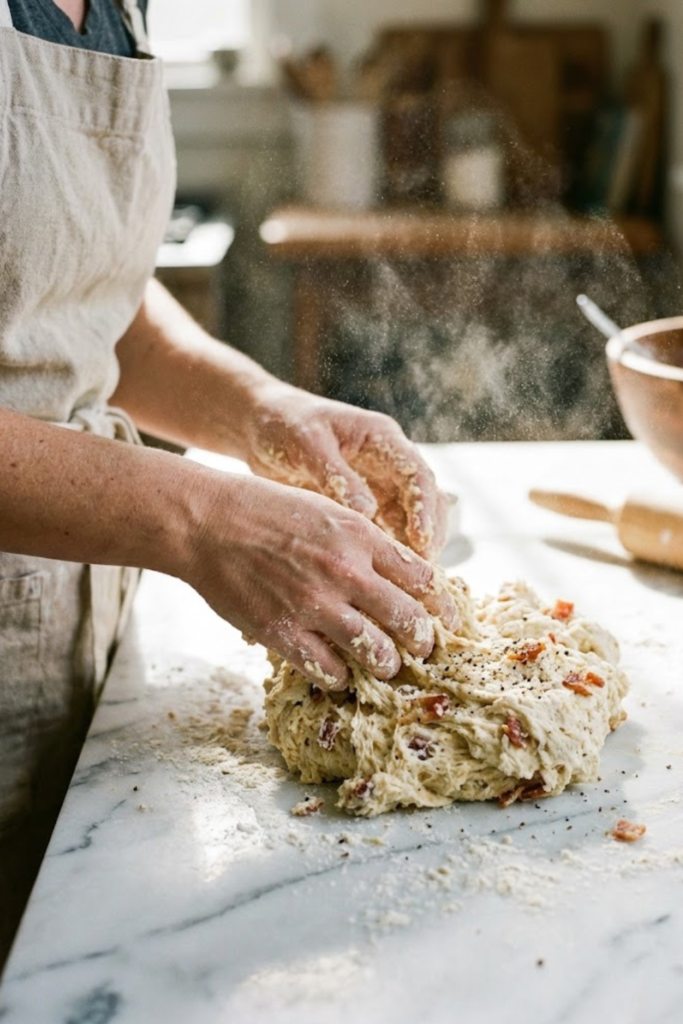
Now for the secret weapon: lamination. It sounds super technical, like something you’d do in a factory, but it’s just folding. Dump that messy dough onto a floured surface.
Pat it down gently into a rectangle. Then, fold it in half like a book. Turn it, pat it down, and fold it again. Do this about 3 or 4 times. This process creates physical layers of dough and butter. When the steam hits those layers in the oven, boom—sky-high biscuits.
Adding the Good Stuff
I usually toss my cheddar, bacon, and black pepper in right before I add the buttermilk, but sometimes they get clumped up. To fix this, I like to sprinkle some of the mix-ins between the layers while I’m doing the folding technique.
This guarantees you get a bite of salty bacon and spicy pepper in every single mouthful. There is nothing worse than biting into a plain biscuit when you were promised bacon! Once you’ve done your folds, pat it down one last time to about an inch thick. Now, step away from the dough. You’re ready to cut.
Baking to Golden Perfection: Time and Temperature
I have ruined more batches of biscuits in the final five minutes than I care to admit. You do all the hard work—freezing the butter, folding the dough, making a mess of the kitchen—and then one wrong move with the cutter ruins everything. It is heartbreaking.
I remember watching my grandma cut biscuits when I was a kid. She moved so fast I couldn’t see what she was doing. When I tried to copy her later in life, I made a classic rookie mistake that doomed my biscuits to being flat discs.
The No-Twist Rule
Here is the most important thing I will tell you today: do not twist the biscuit cutter.
When I first started, I would press the cutter down and give it a little shimmy and a twist to “cut” through the dough. It felt right. But actually, I was sealing the edges. When you twist, you smash the layers of butter and dough together.
If the edges are sealed, the biscuit can’t rise. It just spreads out. You need to press the sharp biscuit cutter straight down and pull it straight up. It takes some practice, but it makes a massive difference in the height. If you don’t have a cutter, use a sharp knife and cut squares. Just don’t use a dull glass cup; it compresses the edges too much.
The Buddy System
Biscuits are social creatures. They like to be close to their friends. I used to space them out on the baking sheet like cookies, thinking they needed room to breathe. Nope.
When you place them on the pan, let the edges touch slightly. As they bake, they will support each other and force the rise upwards instead of outwards. I call it the “biscuit huddle.” This keeps the sides soft and the tops tall.
That Golden Glow
Before these bad boys go into the oven, give them a little spa treatment. If you want that shiny, restaurant-style top, brush them with an egg wash (just an egg beaten with a splash of water).
If you prefer a more rustic, floury look, brush them with a little extra buttermilk. I usually go for the egg wash because I eat with my eyes first, and that deep golden brown color is irresistible.
The Oven Blast
You need a hot oven. I’m talking 425°F (220°C) or even 450°F. We need that high heat to hit the cold butter immediately so it explodes into steam. If the oven is too cool, the butter just melts out and creates a greasy puddle.
Bake them for about 12-15 minutes. You’ll know they are done when the tops are a deep golden brown and the cheese is bubbling. Don’t be afraid to lift one up carefully; the bottom should be browned too. If it’s pale, give it another minute. There is nothing worse than a doughy center!

Serving Suggestions and Storage Tips
Let’s be honest for a second. In my house, a batch of these usually lasts about fifteen minutes. My family swarms the kitchen like hungry seagulls the moment the timer goes off. But, on the rare occasion that we actually have leftovers, or if I’m trying to be organized for a holiday brunch, knowing how to serve and store them makes a huge difference.
I used to just throw leftovers in a plastic bag on the counter. By the next day, they were soft and gummy. I learned that treating these savory scones (as my fancy friends call them) with a little respect keeps them tasting fresh for days.
The Ultimate Breakfast Sandwich
If you want to change your life, use these biscuits as a breakfast sandwich base. I am not exaggerating. Fry up an egg, maybe add a slice of tomato, and slap it between two halves of this biscuit.
Since there is already bacon and sharp cheddar cheese inside the dough, you don’t even really need to add meat. It’s a flavor bomb. I also love serving these alongside a big bowl of spicy chili and soups in the winter. The pepper kick in the biscuit cuts right through the richness of a beef stew.
Level Up with Butter
You might think, “There is already butter and bacon grease in there, do I need more?” The answer is always yes. I like to whip up a quick garlic herb butter while the biscuits are baking.
Just soften some salted butter and mash in some fresh chives or parsley. Smear that on a hot biscuit, and it melts into all those flaky crevices. It turns a simple side dish into the star of the show.
Freezing for Later (The Meal Prep Hack)
Here is my favorite trick for a make ahead breakfast. You don’t have to bake the whole batch at once! I often make the dough, cut the biscuits, and then freeze the raw rounds on a baking sheet.
Once they are rock hard, I toss them into a freezer bag. When I want a fresh biscuit on a Tuesday morning, I just grab one and bake it straight from frozen. Freezing biscuit dough preserves the butter layers perfectly. Just add a couple of extra minutes to the baking time.
The Right Way to Reheat
If you do have baked leftovers, step away from the microwave. The microwave is the enemy of crispy texture. It turns the bacon chewy and the biscuit tough.
For reheating biscuits, I always use my oven or toaster oven set to 350°F for about 5 minutes. If you have one, air fryer biscuits are even better. Pop them in the air fryer for 2-3 minutes, and the edges get crispy again while the inside stays soft. It tastes almost as good as fresh out of the oven.

Making these Black Pepper Cheddar Bacon Biscuits is a labor of love that pays off with every savory bite. Whether you are whipping them up for a holiday brunch or just a treat for yourself, the combination of spicy pepper, salty bacon, and rich cheese is unbeatable.
I still remember the first time I got those layers right—it felt like winning a gold medal. Don’t be discouraged if your first batch isn’t picture-perfect. Baking is all about practice and getting a feel for the dough.
Just remember the golden rules: keep your butter cold, handle the dough gently, and never, ever twist that cutter! If you try this recipe, I’d love to see how it turned out. Please pin it to your Breakfast board on Pinterest and tag me in your photos!